


Let’s stop pretending this is some kind of industry failure.
No one was doing cryptographic inventories. Everyone knows that. And it was not negligence or ignorance. It was rational behavior. No one asked for it. Nothing enforced it. Nothing broke.
So cryptographic inventory never existed as a real practice.
What did exist was scanning.
Now that organizations are suddenly being told they need an inventory, a whole lot of vendors are scrambling to rebrand scanners as something they have never been.
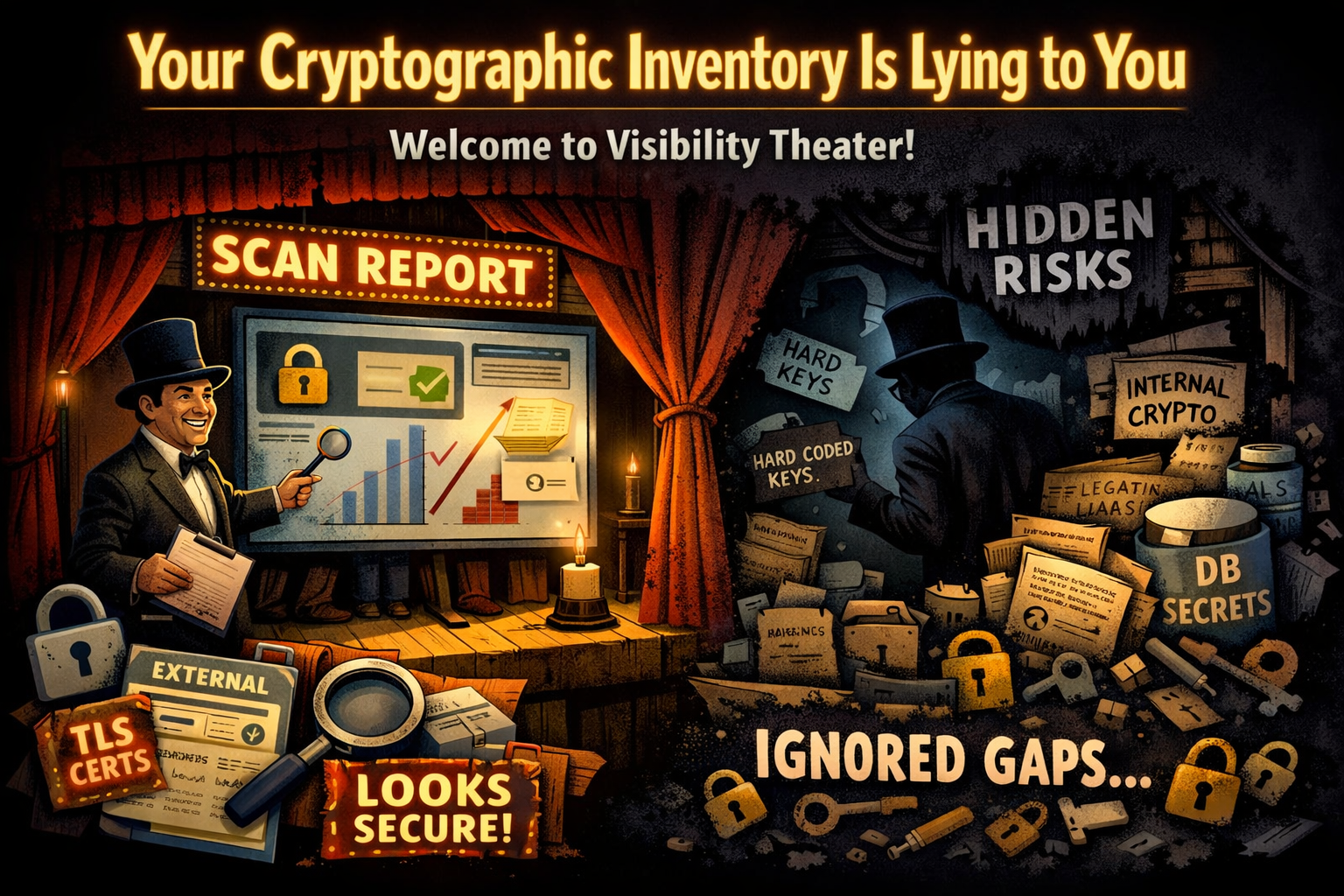
Run nmap. Grab what responds. Collect external TLS. Maybe catch a few certificates. Dump it into a report. Call it “comprehensive.” Hope no one asks about internal services, embedded crypto, application libraries, keys in code, databases, or anything that does not shout back over the network.
That is not inventory. That is visibility theater.
For years, this worked because completeness was never the goal. Plausibility was. Produce something that looked official enough to move on. Everyone in the room understood the gaps. They just did not matter.
Until they did.
Now governments and regulatory bodies are explicitly mandating that organizations understand their cryptographic exposure. Not just what is internet-facing. Not just what scans cleanly. All of it. And suddenly the industry is acting like this new expectation is the same thing they have always been doing.
It is not.
A scanner shows you what it can see.
An inventory tells you what exists.
Those are fundamentally different problems.
This is where the scanner story collapses. Cryptography does not primarily live on the wire. It lives inside systems. Inside applications. Inside databases. Inside devices. Inside code repositories. In certificate authorities. In key management systems. In cloud control planes. In places scanners will never reach.
QryptoCyber was built on a simple premise. If cryptography lives inside your IT and infosec infrastructure, that is where inventory has to come from. Not from guessing. Not from probing. From connecting directly to the systems that create, manage, deploy, and enforce cryptography in the first place.
No one is confused about why inventories never happened.
They never happened because no one asked.
Now people are asking. And pretending that yesterday’s tools were designed for today’s expectations is how you end up with a very confident, very wrong answer.
Stop pretending scanners equal strategy
Scanners are good at finding what they are designed to find. That is the problem.
They miss cryptography embedded in applications, stitched into business logic, hiding in third-party services, baked into databases, or quietly living in internal traffic flows no one has looked at in years. Running more scans does not fix this. It just gives you more false confidence.
Most organizations start “discovery” by pointing a scanner at the environment and calling it a plan. That is not planning. That is reconnaissance theater.
Scanners find what they can see from where they stand. They do not understand business context, ownership, data sensitivity, or how cryptography is actually woven through applications, databases, identity systems, cloud services, and third-party platforms. They do not know what matters to regulators, risk committees, or security leadership.
Planning a cryptographic inventory means defining scope before discovery. What systems are in scope. What data types matter. Which frameworks apply. Where inherited risk lives. And where cryptography is most likely hiding in places scanners never look.
This is where AI belongs. Not replacing tools, but connecting to your IT and infosec infrastructure to build a defensible inventory plan before anything runs. Yes, we have a scanner too. We just do not pretend it is the answer. It is one input, not the strategy.
Planning a cryptographic inventory is not about firing up tools. It is about understanding how cryptography actually exists across your IT and infosec ecosystem and how it maps to business processes, obligations, and risk exposure.
We connect asset systems, configuration data, identity platforms, cloud APIs, code repositories, and security tooling to define scope, correlations, and priorities before discovery even starts. That is why we do have a scanner, and that is also why we do not recommend starting with it.
Scanners without AI-driven planning are just expensive ways to miss things faster.
Most teams are being forced to care about cryptographic inventory for the first time. Their instinct is predictable. Point a scanner at the environment and call it discovery.
That is not a plan. That is hope with a progress bar.
This is where the conversation actually starts.
Most of the industry is still arguing about tools. About scanners versus agents. About coverage percentages and dashboards. That debate misses the point entirely. The real problem is that cryptographic inventory was never designed as a lifecycle. It was treated as a one-time activity. Run something. Export something. Move on.
That approach collapses the moment inventory becomes mandatory instead of optional.
What works at enterprise scale is not a tool. It is a process. One that acknowledges reality: cryptography is everywhere, it changes constantly, and you cannot manage what you do not understand.
That is why we frame cryptographic inventory around a simple lifecycle:
Plan.
Discover.
Act.
Not as marketing stages. As survival stages.
In Part 1, Plan, we will break down why inventory fails before discovery even starts and how AI-driven planning defines scope, ownership, and priority before a single scan runs.
In Part 2, Discover, we will show why real discovery means connecting to IT and infosec infrastructure, not just probing the network and hoping for the best.
In Part 3, Act, we will explain why CBOMs are useless without context, prioritization, and execution, and how organizations actually turn inventory into risk reduction instead of shelfware.
If your current “inventory” is a report you ran once and have not looked at since, this series is for you.
Because scanners are not lying.
They are just answering the wrong question.